Let Me Show You My Bits
A while back, in Reading Between the Posts, I wired up the home page so the quiet gaps between articles would narrate themselves - “1 bit and 41 changelog events in between”. There was just one tiny problem with that sentence. At the time I had written exactly zero bits.
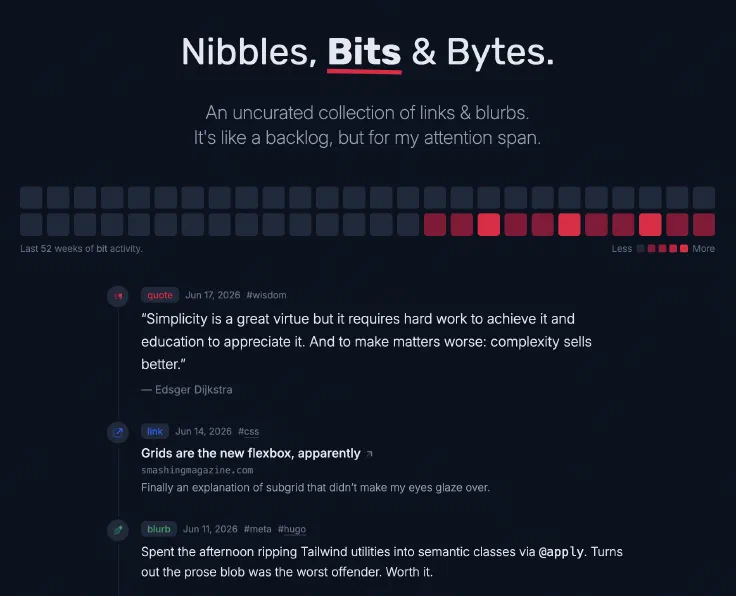
So let me finally show you my bits.
What even is a bit?
A bit is the smallest unit of “I made a thing” I’m willing to commit to. It could be a quote that stuck with me, a link worth keeping, the odd YouTube video, or a one-line thought too small to earn its own long-form entry. Each one is a little markdown file in /bits and the only thing it really has to declare is what kind of bit it is:
---
type: quote
date: 2026-06-17
source: "Edsger Dijkstra"
---
"Simplicity is a great virtue but it requires hard work to achieve it."
type is the whole trick that everything else hangs off.
One shape per thought.
The thing I didn’t want was for a pithy quote to render like a bare link or to render like a video. They’re different shapes of thought, so they ought to look different.
I’d already learned this lesson building the changelog, which leans on one tiny partial per event type. So I stole from myself. There’s a single lookup table mapping each type to an icon, an accent colour and a label:
{{ $meta := dict
  "quote" (dict "icon" "quote-right"    "colour" "rose"    "label" "quote")
  "link"  (dict "icon" "arrow-up-right" "colour" "blue"    "label" "link")
  "video" (dict "icon" "youtube"        "colour" "red"     "label" "video")
  "blurb" (dict "icon" "pen-nib"        "colour" "emerald" "label" "blurb")
}}
It then matches a micro-partial per type that decides how the content actually renders. Adding a brand new kind of bit is now “add one row, add one tiny template”, which is about as many steps as I’m willing to tolerate.
Hugo, why are you like this?
My bits started life with two perfectly reasonable front-matter fields: type and url. Hugo took one look and quietly robbed me of both.
It turns out url is a reserved key which Hugo uses to treat as the page’s permalink. So, the moment I put a https://... in there, the build fell over with a stern little message about unsupported protocols. type doesn’t even have the decency to error. It silently moves out of .Params.type and into .Type, which also hijacks the layout lookup. So my .Params.type was resolving to nothing and every single bit was quietly rendering as the fallback.
Turns out hte fix for this was simply to rename url to link and read .Type instead of .Params.type. Half an hour of my life dedicated to two words I didn’t know were already spoken for.
Coding is my passion.
Bits flapping in the wind.
Rather than dumping bits into the same fold-out list as the GitHub noise, I pulled them out as their own first-class timeline rows. The lower-signal changelog chatter stays tucked behind the “N changelog events in between” disclosure. So, the home page now reads in three tiers:
- the loud headline articles
- the medium-volume bits
- the quiet changelog hum
The same interstitial machinery I built last time, but bits just get to stand a little taller than a commit.

The tag that went nowhere.
Bits are deliberately render: never in Hugo. They live inline on the bits page and never get their own URL. Except “no page” also quietly means “no place in the taxonomy”, which means a tag only ever used by a bit has no /tags/... page to point at. If I link it anyway I’ve shipped a 404.
So, the tags only become links if there’s actually somewhere to go:
{{ with site.GetPage (printf "/tags/%s" (urlize .)) }}
  <a href="{{ .RelPermalink }}">#{{ .Data.Term }}</a>
{{ else }}
  <span>#{{ . }}</span>
{{ end }}
A tag with a real page becomes a link and a bit-only tag stays as plain text. No broken links and the nice part is it heals itself the moment a proper article picks up the same tag.
In closing …
The front page has quietly turned into a proper little stream. Long-form when I’ve actually got something to say, bits when I don’t and a year of squircles up top keeping a tally of it all.
Which is the entire point. The less effort it takes to post a half-formed thought, the more likely I am to actually post it. And the more I post, the more those gaps fill in.
And, as always, you can check everything out for yourself in the repo.
1 revision since publication
- 3d8bd97 +1 −7 new design refresh yay
- 1a9cd36 +101 −0 published
Comments